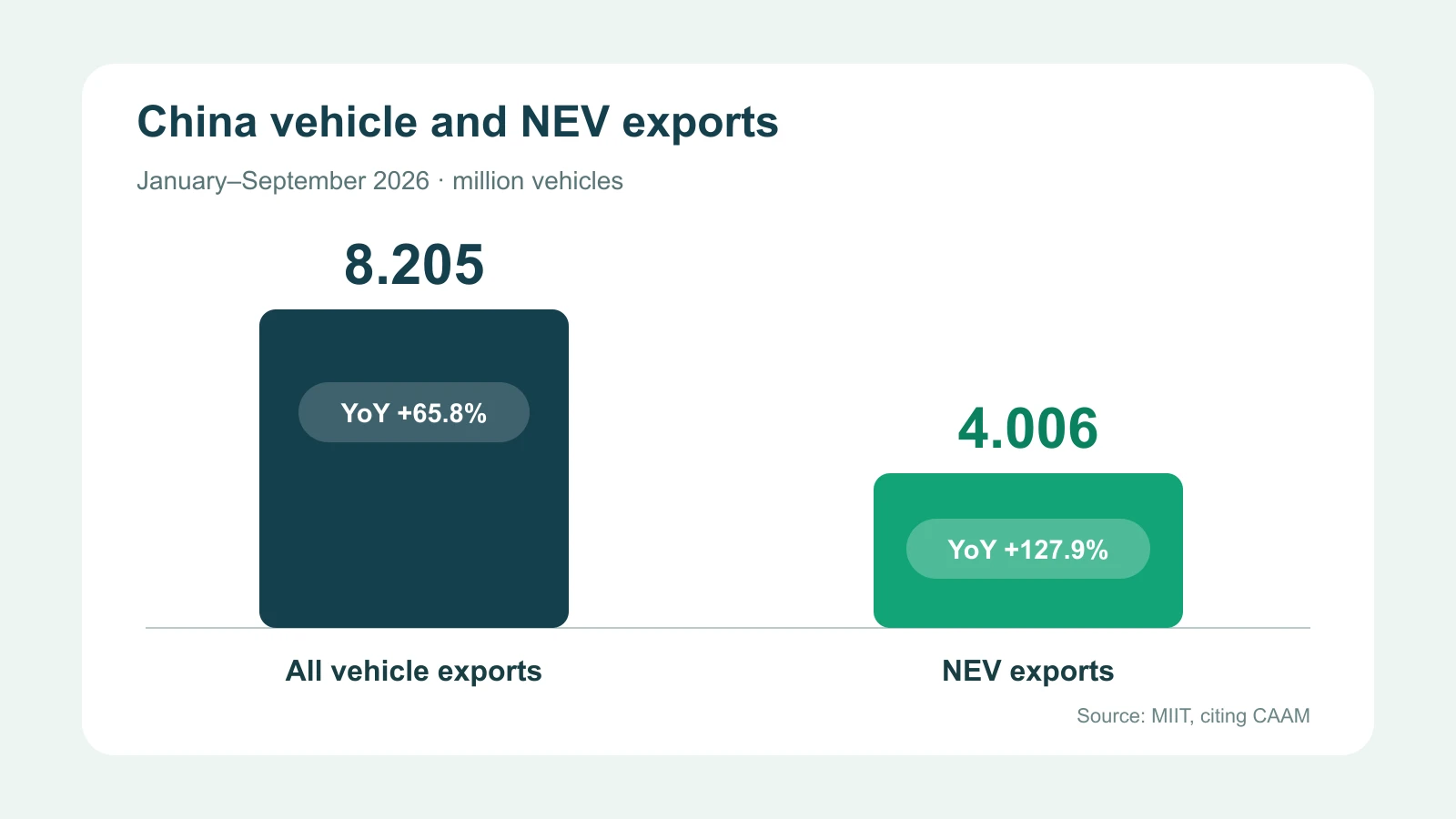
China’s new-energy vehicle exports crossed 4 million during the first nine months of this year. Data published by the Ministry of Industry and Information Technology on 12 October show exports of 4.006 million NEVs from January to September 2026, up 127.9% year on year. Total vehicle exports reached 8.205 million, up 65.8%. The figures are attributed to the China Association of Automobile Manufacturers.
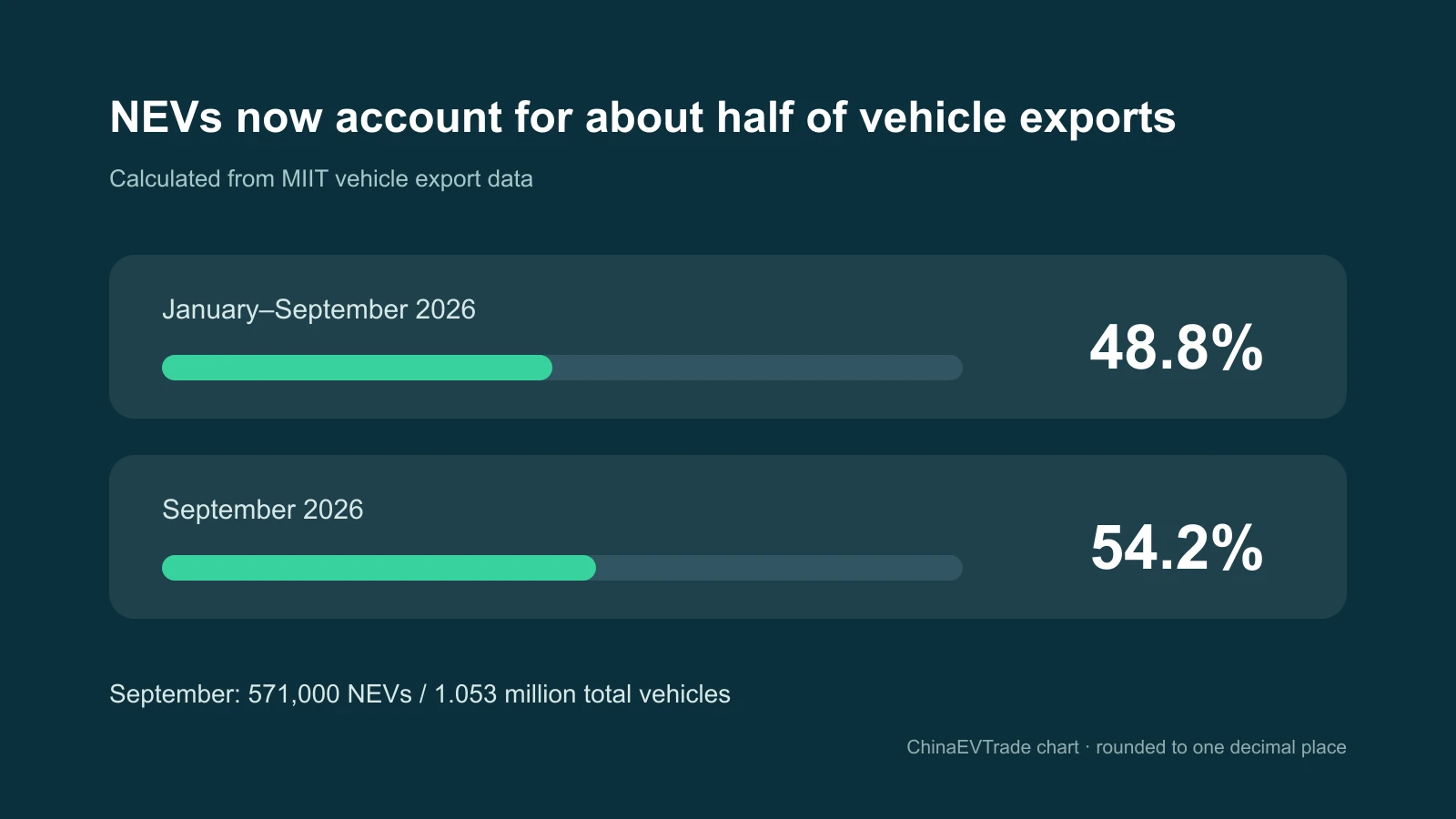
September was even stronger: China exported 1.053 million vehicles, including 571,000 NEVs, an increase of 157.2% from a year earlier. Based on those figures, NEVs represented 54.2% of vehicle exports for the month.
What does the 4-million mark mean?
First, look at the mix. Using the official totals, NEVs accounted for about 48.8% of China’s vehicle exports in the first nine months. Battery-electric and plug-in hybrid vehicles are no longer a side category; they are now a central part of China’s automotive exports.
For buyers, higher export volume usually means more brands, body styles and powertrains across different budgets. It does not mean every model is selling equally well in every country. The national data do not show destination markets and cannot replace local registration data, import rules or customer research.
More models make version checks more important
The same model may use different charging ports, software languages, connectivity services and equipment packages in China and in an export market. LHD and RHD supply schedules may also differ. Buyers need to confirm not only that a vehicle is available, but that the exact version can be registered and used in the destination country.
BEVs, PHEVs and range-extended vehicles should not be compared under one set of operating conditions. Where charging is reliable, a BEV can deliver a stronger daily-cost advantage. In markets with limited charging or frequent long-distance travel, a plug-in hybrid or another powertrain may be more practical. Start with the customer’s routes, not only the advertised range and domestic price.
Six points overseas buyers should confirm before ordering
- Factory LHD or RHD version
- Charging connector, local AC standard, fast-charging compatibility and supplied equipment
- Powertrain, battery, software language, maps and connected functions
- Vehicle identity, export documents and destination-country requirements
- Domestic transport, port, ocean freight, insurance and landed costs
- Common parts, diagnostic support and local repair capability
These checks are less dramatic than a 4-million export headline, but they determine what happens after the vehicle arrives. The wider the choice, the more carefully buyers must identify the exact version behind a model name.
RHD markets gain more choice—but steering position is only the start
Chinese automakers are preparing more RHD models, including a growing range of NEVs. This gives buyers in Southeast Asia, Africa and Oceania more options. Yet RHD is only the first requirement: local approval, charging standards, hot-climate suitability, parts support and delivery times still need model-by-model confirmation.
ChinaEVTrade focuses on wholesale and export of Chinese new-energy vehicles. We help overseas buyers verify models, steering position, configuration, export documents and shipping plans. Our aim is to deliver vehicles suited to the destination—not to use a national export figure as a sales forecast for every market.
Ministry of Industry and Information Technology: China auto industry data for September 2026
CREA: China energy and emissions trends, September 2026 snapshot
Xinhua: 7,273 new-energy vehicles shipped from Nantong to Europe (cover photo)
This article reflects information available at its original publication date. Vehicle specifications and destination requirements should be confirmed for the exact vehicle and shipment.