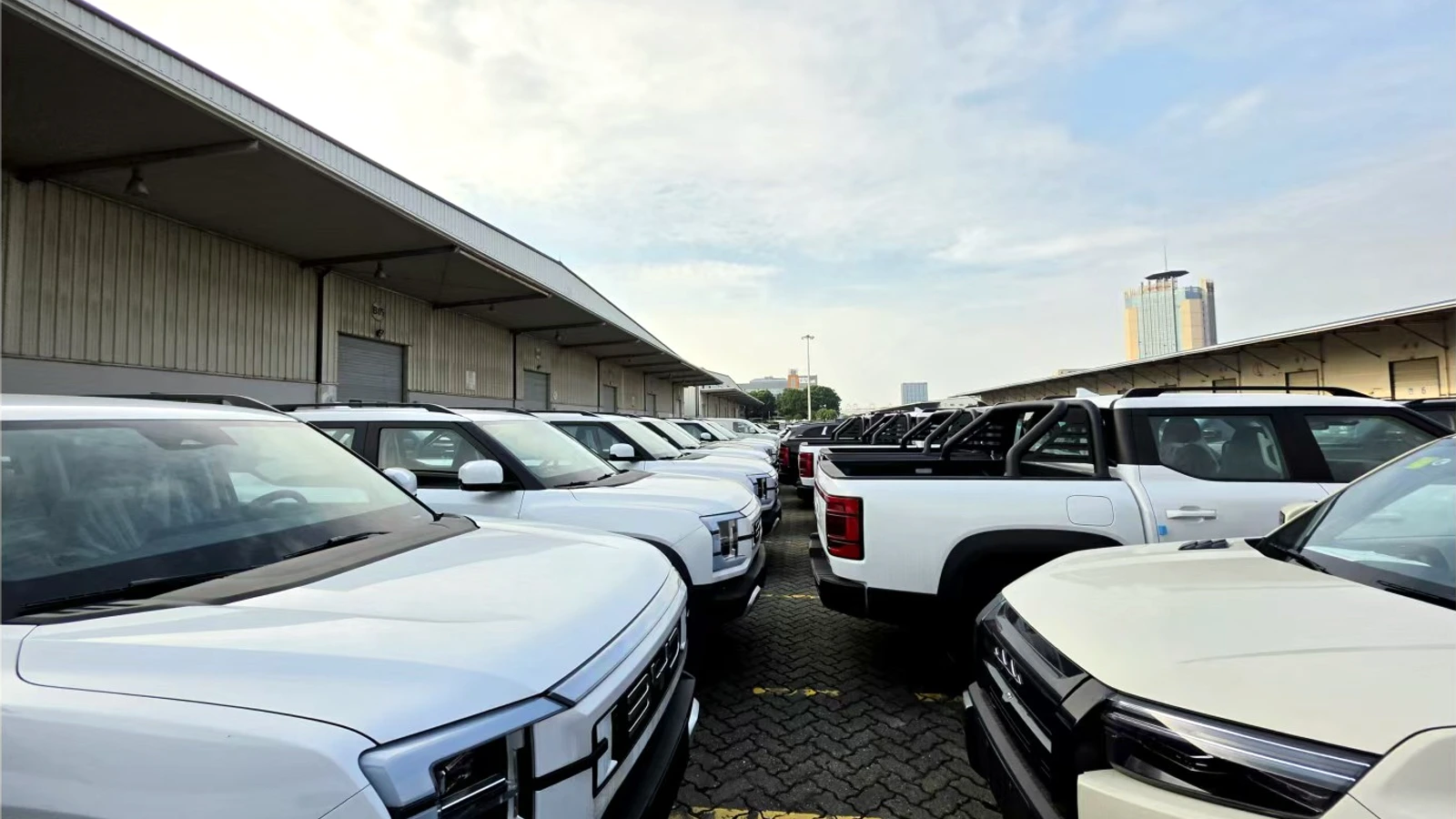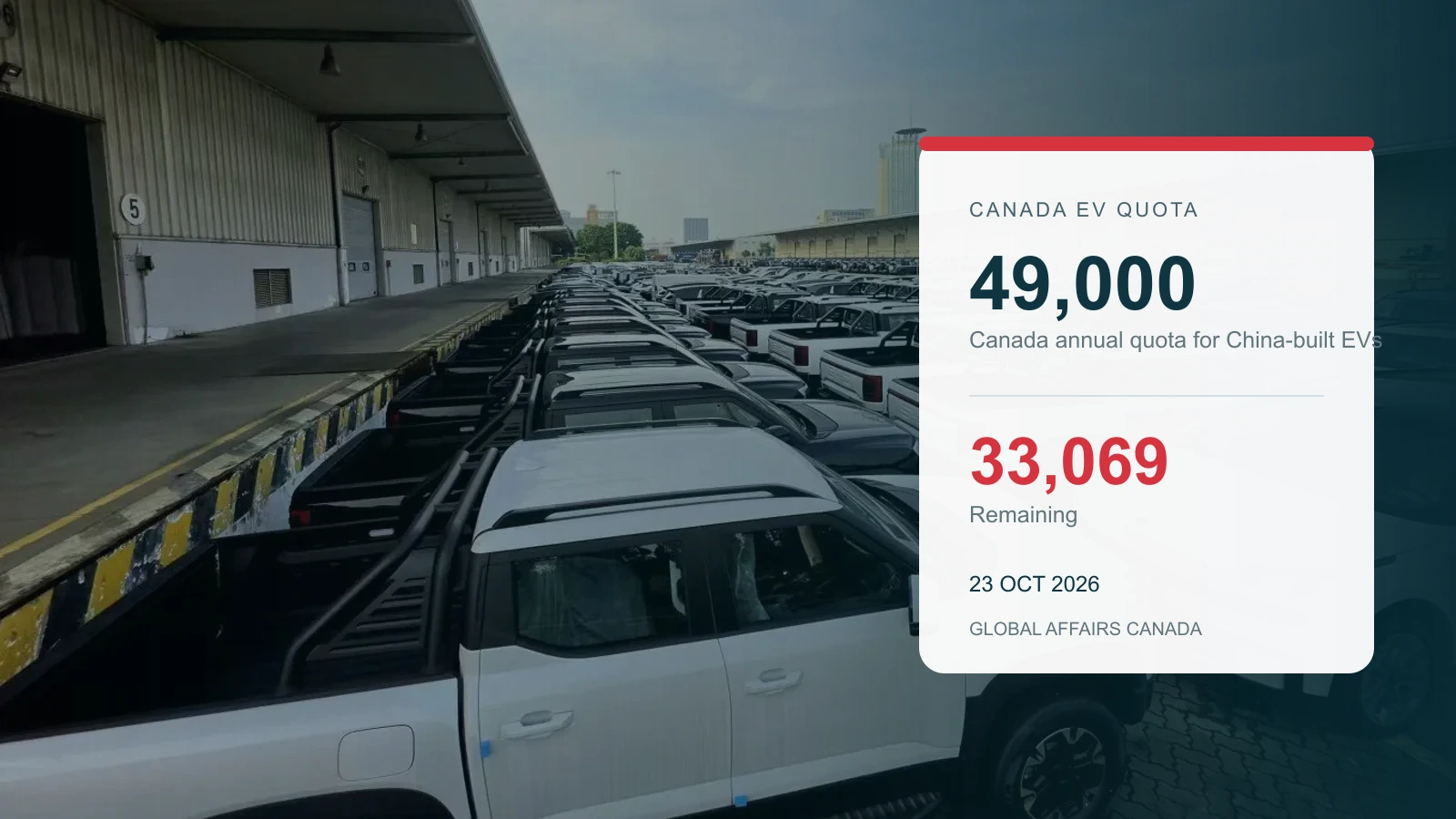
The revealing part of these figures is not whether Canada wants Chinese vehicles. It is the distance between a tariff change and an actual delivery: market approval, the exact vehicle version, import permits, retail and after-sales support. For an overseas buyer, those steps can determine whether a purchase is workable long before a quotation does.
How much of the 49,000-vehicle quota has been used?
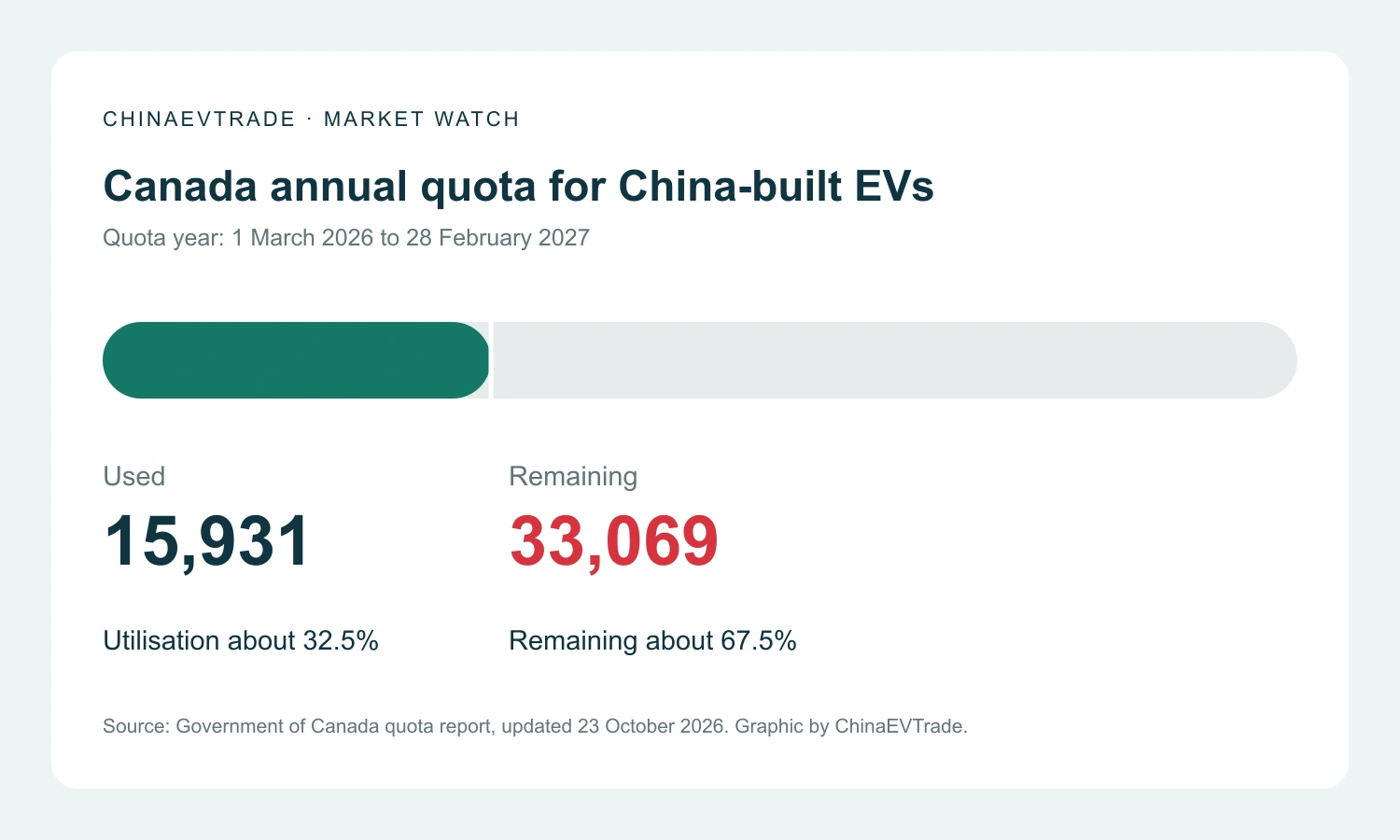
The quota year runs from 1 March 2026 to 28 February 2027. The official report records 15,931 vehicles against a maximum of 49,000, an utilisation rate of about 32.5%. The remaining 33,069 vehicles represent roughly 67.5% of the annual quota.
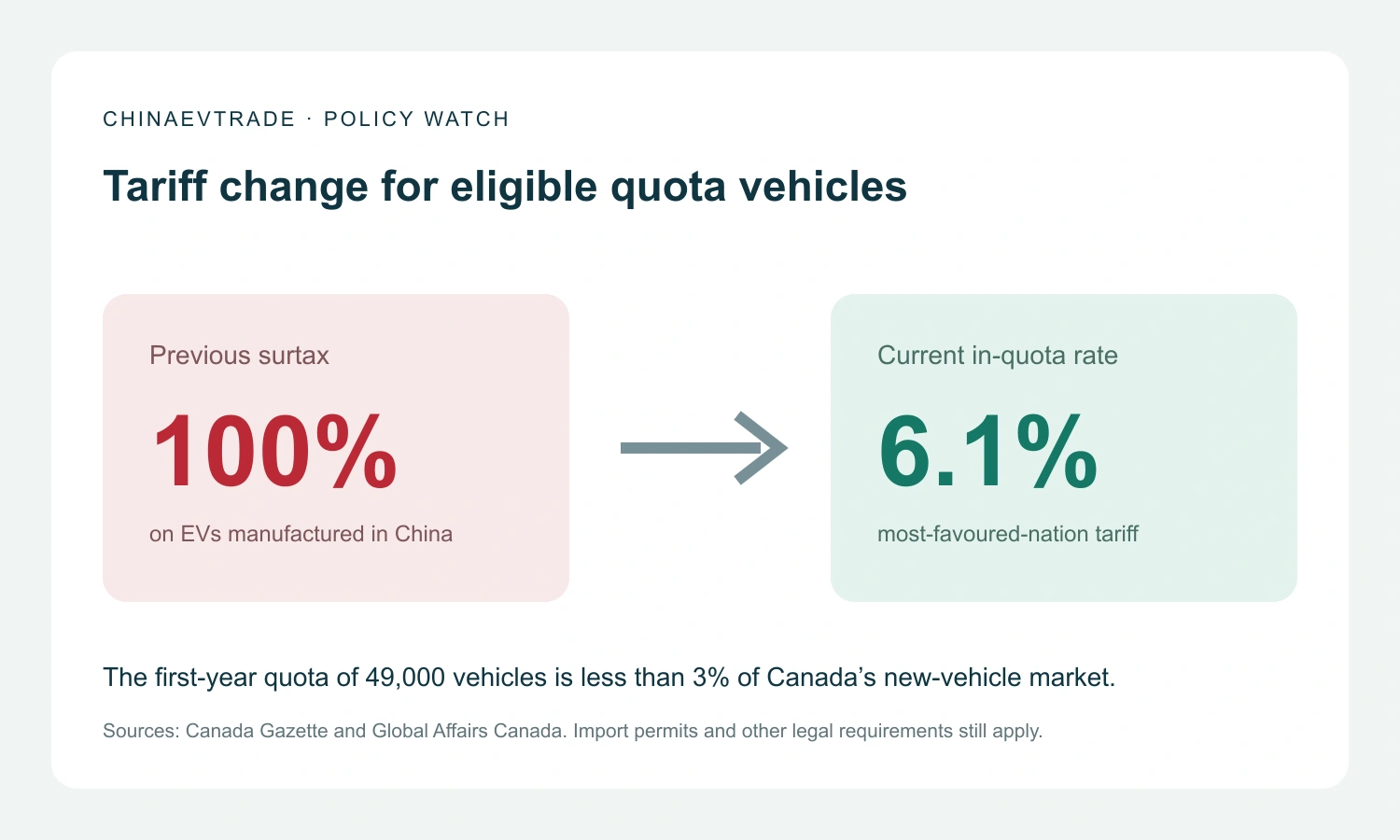
Under the current Canadian rules, eligible vehicles imported within the quota are subject to the 6.1% most-favoured-nation tariff. The previous 100% surtax on EVs manufactured in China has been repealed. On tariff alone, that is a substantial change.
One distinction matters: Canada counts vehicles substantially manufactured in China, not vehicles by the nationality of the badge. The public report groups battery-electric and plug-in hybrid vehicles by customs code and does not identify brand volumes. The 15,931 vehicles therefore cannot all be attributed to BYD, Geely, Chery or other Chinese brands.
Tariffs are lower, so why have imports not accelerated?
Part of the answer lies in the import rules. An applicant must be a Canadian resident and an EV original equipment manufacturer; a non-resident manufacturer may appoint an eligible Canadian resident as its agent. Each shipment also requires a specific import permit. A vehicle without that permit cannot enter under the quota.
The permit is not the whole approval process. The official notice says importers must also comply with requirements administered by the Canada Border Services Agency, Transport Canada and other applicable rules. The quota determines how many vehicles can enter at a given tariff; it does not automatically approve a model for sale and registration.
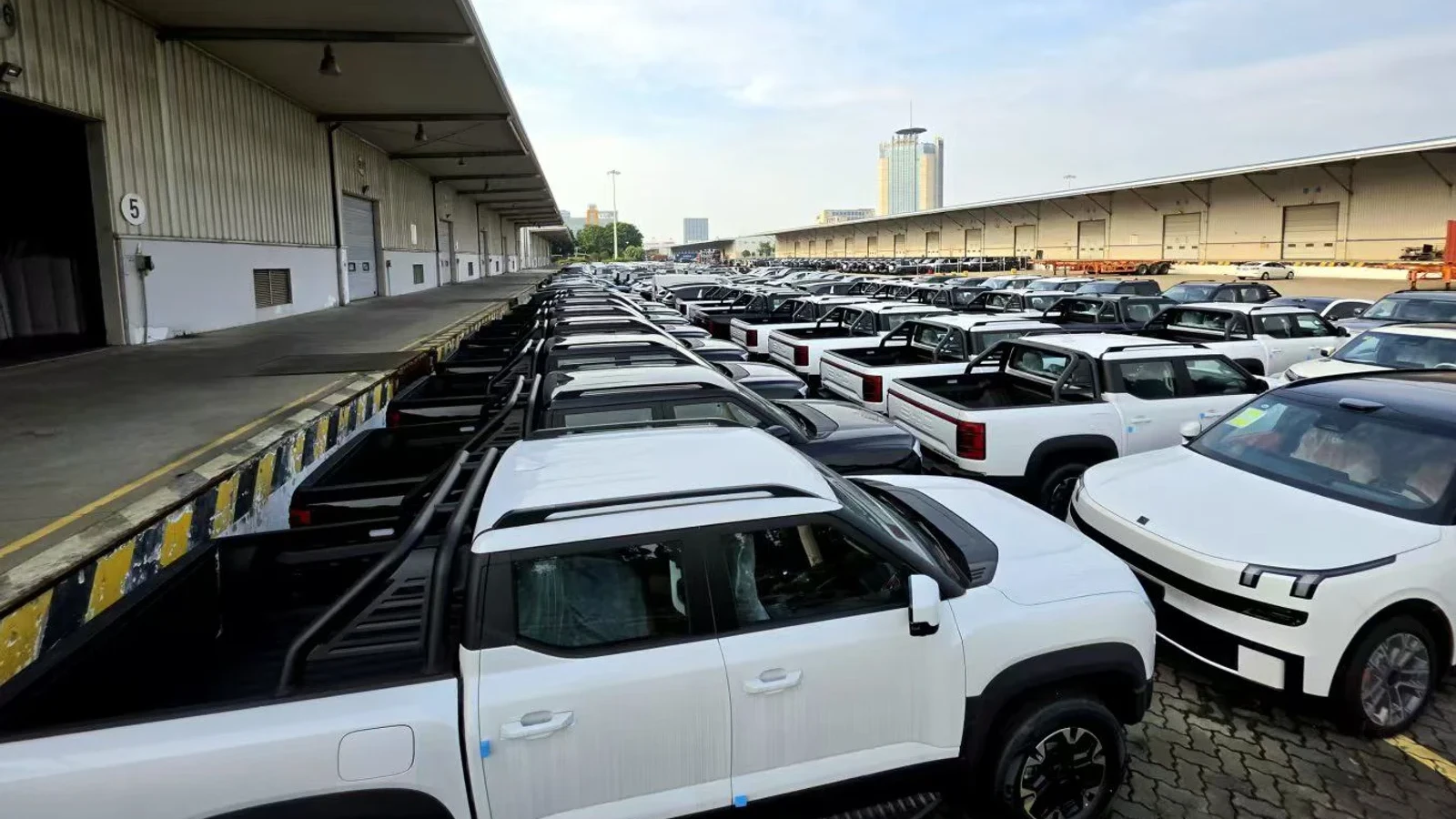
Recent industry reports indicate that several Chinese automakers are preparing for Canada, but their first models, final prices, dealer numbers and delivery dates have not all been announced. In mid-October, Tesla also paused orders for some China-built Model 3 versions in Canada, saying its company allocation was exhausted while the national quota still had more than 33,000 spaces. Canada has not disclosed company-level allocations, so no outside observer can calculate how many permits each manufacturer has available.
That explains the apparent contradiction. Unused space in the national quota does not mean any company can immediately claim it, and it does not mean a model currently sold in China has completed everything required for Canada.
The harder barriers often sit outside the quota
Entering a new market normally begins with a market-specific vehicle. Charging connectors, lighting, units on the instruments, software languages, connectivity, driver-assistance functions and safety equipment may differ from the China-market version. The same model name is not proof of the same specification.
Retail and after-sales networks are not details to be added after a launch. Buyers need to know where parts will come from, who can diagnose faults, how battery cases will be handled and whether connected software works locally. Those questions shape consumer confidence and the amount of inventory an importer is prepared to hold.

It is too early to say whether the remaining 33,069 spaces will now be used more quickly. New brand entries, changes in production origin or a revised Canadian allocation method could all affect the figures. Until manufacturers publish firm models, prices and delivery plans, preparation should not be reported as completed market entry.
What this means for overseas vehicle buyers
Canada illustrates an often overlooked point: a lower tariff is only one purchasing condition. Before asking what a vehicle costs in China, a buyer needs to know which version is entering the destination country, who is authorised to import it, whether it can be registered and how parts and technical support will be provided after delivery.
For dealers and volume buyers, the checks fall into three groups: suitability for local use, complete import and registration documents, and workable support after delivery. Once those are clear, price and volume discussions become far more reliable.
ChinaEVTrade follows the overseas supply of Chinese new-energy vehicles and changes in destination markets. Our role is not to describe every market as open, but to match the model, version and export process to the buyer’s country, intended use and purchasing plan, and to identify likely issues before shipment.
This is an original ChinaEVTrade industry analysis. Public data are current to 23 October 2026. Quota utilisation, model plans and import rules may change; the latest information from the Canadian government and manufacturers should take precedence.
Government of Canada: 2026–2027 China EV quota utilisation report
Government of Canada: rules for imports of EVs from China (Serial No. 1162)
Canada Gazette: quota, tariff and import-control explanation
Recent report: 33,069 China-EV quota spaces remain unused
Related: ChinaEVTrade vehicle catalogue
Related: vehicle sourcing and export services
Related: three smart EVs enter Thailand’s RHD market
This article reflects information available at its original publication date. Vehicle specifications and destination requirements should be confirmed for the exact vehicle and shipment.